The Thirteen Gates of Lahore
Thirteen arches once guarded the Walled City — six still stand, and every Lahori still navigates by their names.
Age
Walls and gates rebuilt under Mughal Emperor Akbar after 1584 — more than 440 years ago
Origin
Walled City of Lahore (Androon Shehar), Punjab, Pakistan
Find it now
Six gates survive in Lahore today — Bhati, Delhi, Kashmiri, Lohari, Roshnai and Shairanwala; start at Delhi Gate and walk the Shahi Guzargah Royal Trail
Walk around old Lahore today and people still give directions by gates that no longer exist. For centuries the Thirteen Gates were the only way in and out of the Walled City, known as Androon Shehar, the inner city. Enclosed by a nine-metre-high brick wall, the gates served as both protection and passage — closing at sunset against intruders, and opening by day to traders, travellers and residents.
The walls took their lasting shape under the Mughal Emperor Akbar. After 1584, when Akbar shifted his capital to Lahore, he ordered the walls rebuilt, fortified and extended eastwards, and Lahore's old gates were built around this time. He also founded the Akbari Mandi grain market — still trading today, long after the Akbari Gate beside it has gone. Together the thirteen read like a map: Akbari, Bhati, Delhi, Kashmiri, Lohari, Masti, Mochi, Mori, Roshnai, Shahalmi, Shairanwala, Taxali and Yakki.
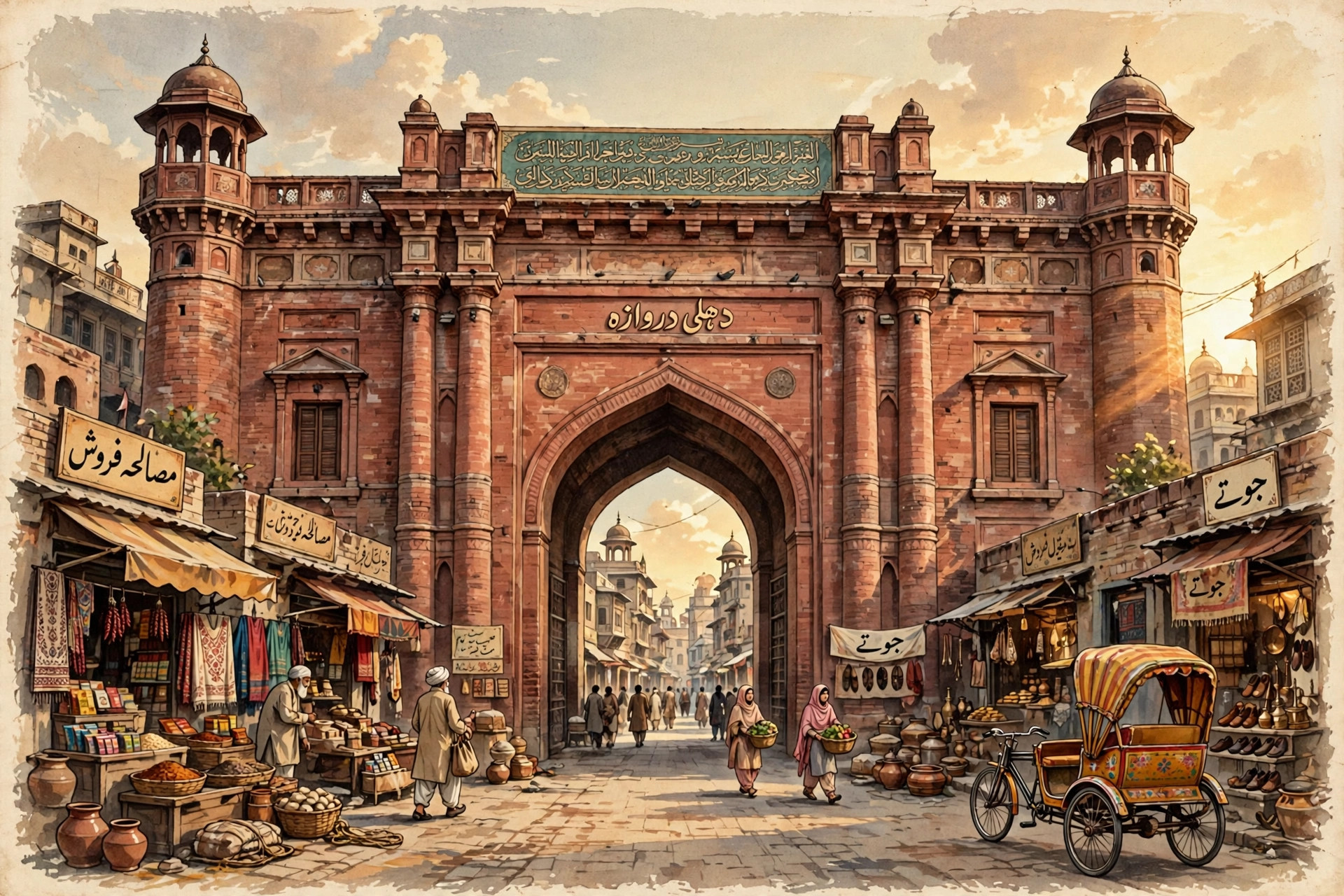
Some names tell their stories by themselves. Delhi Gate faced east, onto the road to Delhi, and was among the busiest, leading inside to the Shahi Hammam royal baths and the Wazir Khan Mosque along the Shahi Guzargah, the Royal Passage to the Lahore Fort. Lohari Gate took its name from the lohar — blacksmith — workshops outside it, and Taxali Gate stood by the royal mint, the taksal. The thirteenth, Mori Gate, was never an official gate at all: squeezed between Lohari and Bhati, it was the smallest opening, used to take waste out of the city — yet residents insisted on counting it, and still do.
Under Maharaja Ranjit Singh, the city's defences were refurbished in 1812 with a second circuit of walls following the Akbari outline. At Shairanwala Gate — originally Khizri Gate — Ranjit Singh placed two live lions in cages, as a symbolic warning to enemies; shairanwala means 'of the lions'. Roshnai Gate, the Gate of Lights between the Lahore Fort and the Badshahi Mosque, was lit in the evenings for the courtiers who passed through it — and it is the only gate that still largely remains in its original state.
The end came after the uprising of 1857. To de-fortify the city, the British destroyed Lahore's city walls and almost all its gateways. Several were later rebuilt — the Delhi Gate you see today is a 19th-century British building, set a little east of the Mughal original. Shah Alami Gate burned during the riots that accompanied Partition in 1947; today only its name and its great market survive.
Six of the thirteen still stand: Bhati, Delhi, Kashmiri, Lohari, Roshnai and Shairanwala. Since 2012 the Walled City of Lahore Authority has cared for the old city, and its Shahi Guzargah Project restored the Royal Passage between Delhi Gate and the Wazir Khan Mosque, its first phase completed in 2015. Enter at Delhi Gate in the morning, and the gates become, as they always were, the doors of a living city.
Sources
- Wikipedia — Walled City of Lahore (Gates, History and Conservation sections)
- The News on Sunday — Reflection: The gates of Lahore
- Walled City of Lahore Authority — History of Lahore's Walled City
Every fact in this exhibit was checked against the sources above. If you spot an error, write to us at downloadkaro.pk@gmail.com and we will correct it.