Mohenjo-daro
Four and a half thousand years ago, someone planned this city street by street — and sealed its Great Bath watertight with tar.
Age
Built about 2500 BCE — around 4,500 years old
Origin
Built by the Indus Valley (Harappan) Civilisation on the right bank of the Indus River, in present-day Sindh
Find it now
An open archaeological site in Larkana District, Sindh, about 28 km from Larkana city — a UNESCO World Heritage Site since 1980
On the right bank of the Indus River in Sindh, about 28 kilometres from Larkana, a landscape of baked-brick walls rises out of the plain. This is Mohenjo-daro, whose modern Sindhi name is interpreted as 'Mound of the Dead Men'. Its original name is unknown — its people left writing behind, but the Indus script has never been deciphered, so the city speaks for itself through its streets, wells and baths. And it speaks clearly.
Mohenjo-daro was built around 2500 BCE and was one of the largest settlements of the Indus Valley Civilisation, contemporary with ancient Egypt and Mesopotamia. At least 40,000 people are estimated to have lived here. The city stands in two parts: to the west, the Citadel, a mud-brick mound around 12 metres high carrying the great public buildings; to the east, the much larger Lower City, where the people lived and worked.
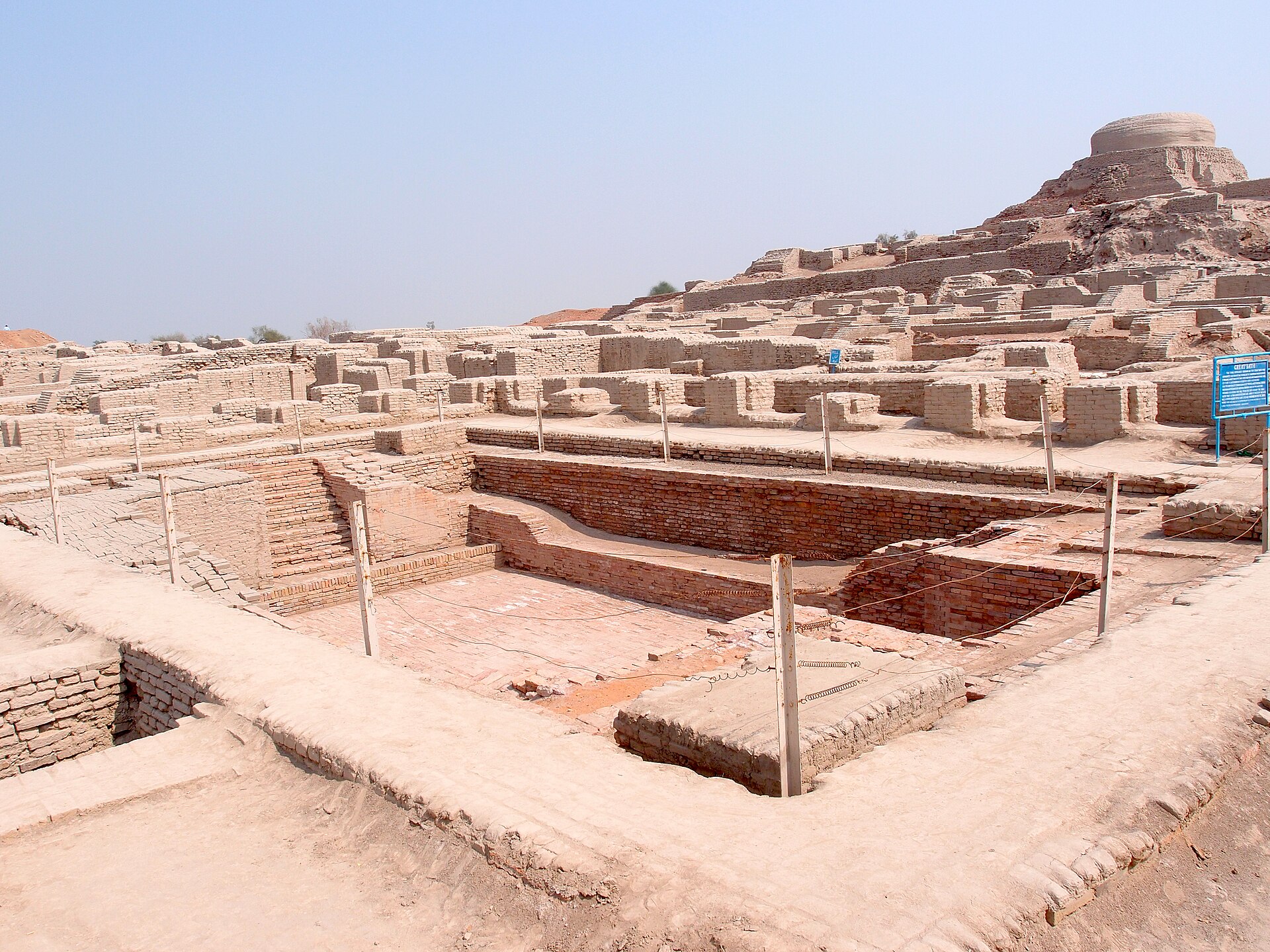
What astonishes every visitor is the planning. Mohenjo-daro was laid out on a grid, its rectilinear buildings arranged along streets that intersect at right angles — UNESCO calls it the most ancient planned city on the Indian subcontinent. Most buildings were made of fired, mortared brick. Households drew water from smaller wells — excavations have found more than 700 wells in all, one for every three houses — Waste water ran away through covered drains lining the major streets. Many houses had inner courtyards and rooms set aside for bathing, and some rose to two storeys.
On the Citadel stands the city's most famous building: the Great Bath. From a colonnaded courtyard, steps lead down into a brick-built pool measuring about 12 metres long, 7 metres wide and 2.4 metres deep. Its builders fitted the bricks tightly and waterproofed the pool with a lining of bitumen — natural tar — so that it would hold water. Close by stood the great granary. Nobody can prove what the Bath was for, but it is widely thought to have been used for religious purification — a shared ritual at the city's heart.
The city prospered for several centuries, and by about 1700 BCE it had been abandoned along with the other large cities of the Indus civilisation. Its ruins then lay undocumented for some 3,700 years, until R. D. Banerji of the Archaeological Survey of India recognised its antiquity in 1919–20; the discovery is dated to 1922, and large-scale excavations followed. In the 2nd century CE a Buddhist stupa was built of unbaked brick over the Citadel's ruins — one civilisation building on another's bones.
In 1980 Mohenjo-daro became a UNESCO World Heritage Site — the first in South Asia. UNESCO calls it the best preserved urban settlement in South Asia from the beginning of the 3rd millennium BC. The protected area covers 240 hectares, of which only about one third has been excavated since 1922. Its foundations are threatened by saline action as the Indus water table rises — the city that mastered water 4,500 years ago is now in a slow fight against it.
Sources
Every fact in this exhibit was checked against the sources above. If you spot an error, write to us at downloadkaro.pk@gmail.com and we will correct it.