Hatshepsut, the Woman Who Became King
She ruled Egypt as a king — and after her death, her statues were smashed and her name erased
Age
Carved ca. 1473–1458 B.C. — about 3,500 years old (New Kingdom, Dynasty 18)
Find it now
The Metropolitan Museum of Art, New York (Object 29.3.2)
Origin
Deir el-Bahri, Thebes, Egypt — from beside Hatshepsut's temple; excavated by the Met's Egyptian Expedition, 1926–28
About 3,500 years ago, Egypt was ruled by a king who was also a woman. Hatshepsut, described by the Metropolitan Museum of Art as the most successful of the several female rulers of ancient Egypt, had been in the public eye since childhood — first as the daughter of King Thutmose I, then as the principal wife of her half-brother Thutmose II, then as regent for her young stepson and nephew, Thutmose III. Then, sometime between years 2 and 7 of the young king's reign, she took the final step and declared herself king, adopting the full titulary of a pharaoh, including the throne name Maatkare.
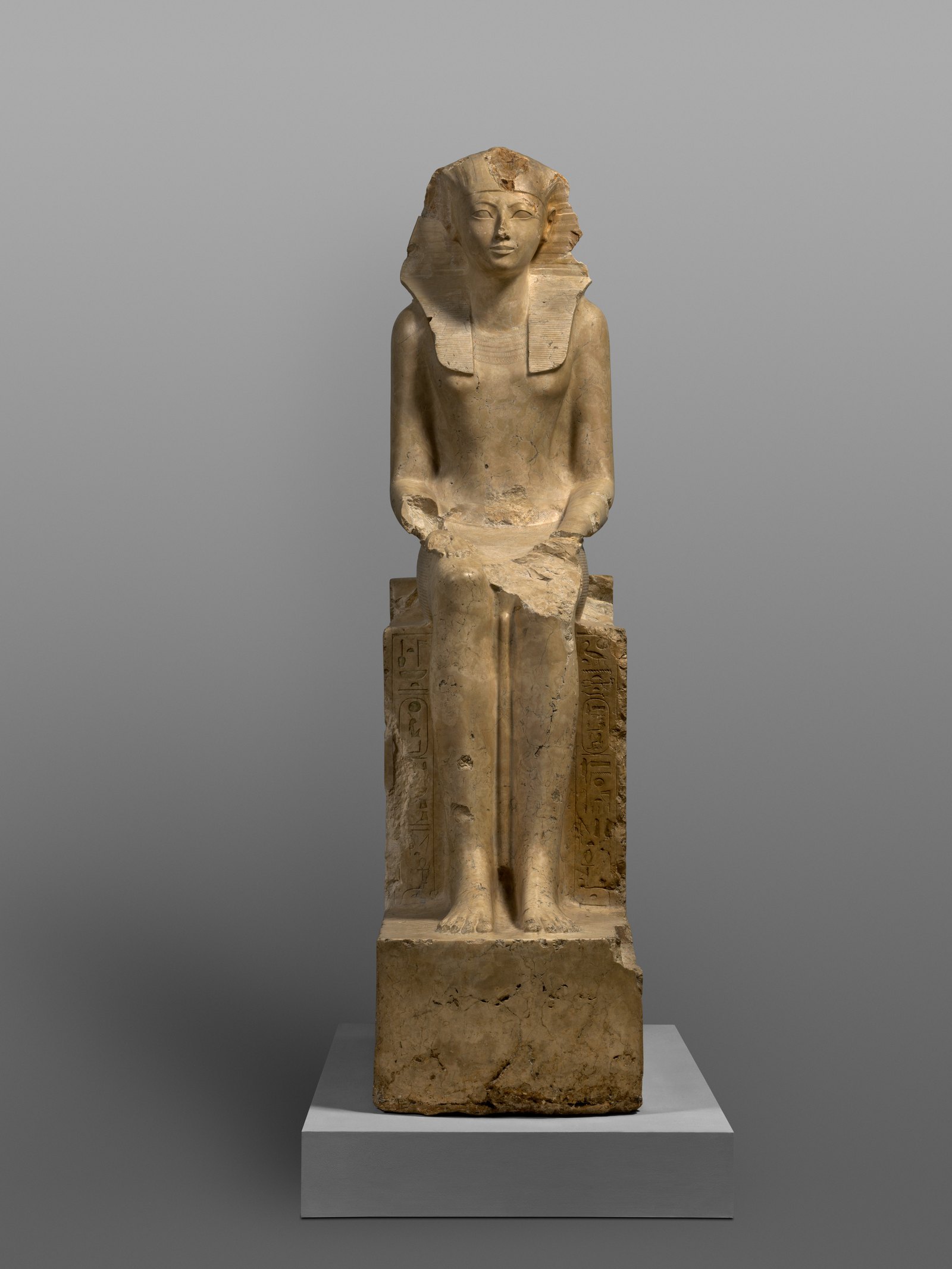
This life-size statue, carved in indurated limestone around 1473–1458 B.C., shows exactly how she wanted to be seen. She wears the striped nemes-headcloth and the shendyt-kilt, part of the ceremonial dress of the Egyptian king — a role that was traditionally a man's. Yet the sculptor did not disguise her: the figure keeps a distinctly feminine air, and the kingly titles carved on the sides of her throne were feminised to call her 'the Perfect Goddess, Lady of the Two Lands' and 'Bodily Daughter of Re.' Her own personal name, Hatshepsut, means 'foremost of noble women.'
The statue was made to receive offerings. Seated figures like this one, with hands resting flat on the knees, were probably placed in the quieter chapels on the upper terrace of her temple at Deir el-Bahri in Thebes, while more public areas displayed her as the ideal young male king. The polished stone was once enlivened with paint: traces of blue pigment still survive in some of the hieroglyphs, and a fragment shows that the pleats of her headcloth were originally painted in alternating blue and yellow. Housed in a shrine, the figure would have caught the morning sun as the shrine doors opened at sunrise, seeming to bring her spirit alive to receive its offerings.
Her story did not end with her death — it was attacked. The Met's curators tell us that about twenty years after Hatshepsut died, Thutmose III, now ruling alone, had her statues smashed and her name erased everywhere it was written. His reasons are still not completely clear. The broken pieces were left near her funerary temple, and there they lay for more than three thousand years.
In 1926–28, the Museum's Egyptian Expedition excavated the fragments near Deir el-Bahri and the Senenmut Quarry, and the painstaking work of reconstruction began — the Met compares it to solving many jigsaw puzzles at once, with pieces mixed together and some missing. This statue, which weighs 1,247.4 kilograms (2,750 pounds), still shows its history in its breaks and cracks, and it is all the more powerful for it: a ruler who claimed a throne that was never meant for her, was deliberately erased, and — fragment by fragment — has been put back together for the world to see.
Sources
- The Met — Seated Statue of Hatshepsut, Object 29.3.2
- The Met — The Female Pharaoh Hatshepsut, Object 29.3.3
- The Met Open Access API record for Object 544450 (isPublicDomain: true)
Every fact in this exhibit was checked against the sources above. If you spot an error, write to us at downloadkaro.pk@gmail.com and we will correct it.