William the Hippopotamus
A palm-sized blue hippo from an Egyptian tomb who became a great museum's beloved mascot
Age
Made ca. 1961–1878 B.C. — about 4,000 years old (Middle Kingdom, Dynasty 12)
Find it now
The Metropolitan Museum of Art, New York — Gallery 111 (Object 17.9.1)
Origin
Meir, Egypt — found in a shaft by the tomb chapel of the steward Senbi II (Khashaba excavations, 1910)
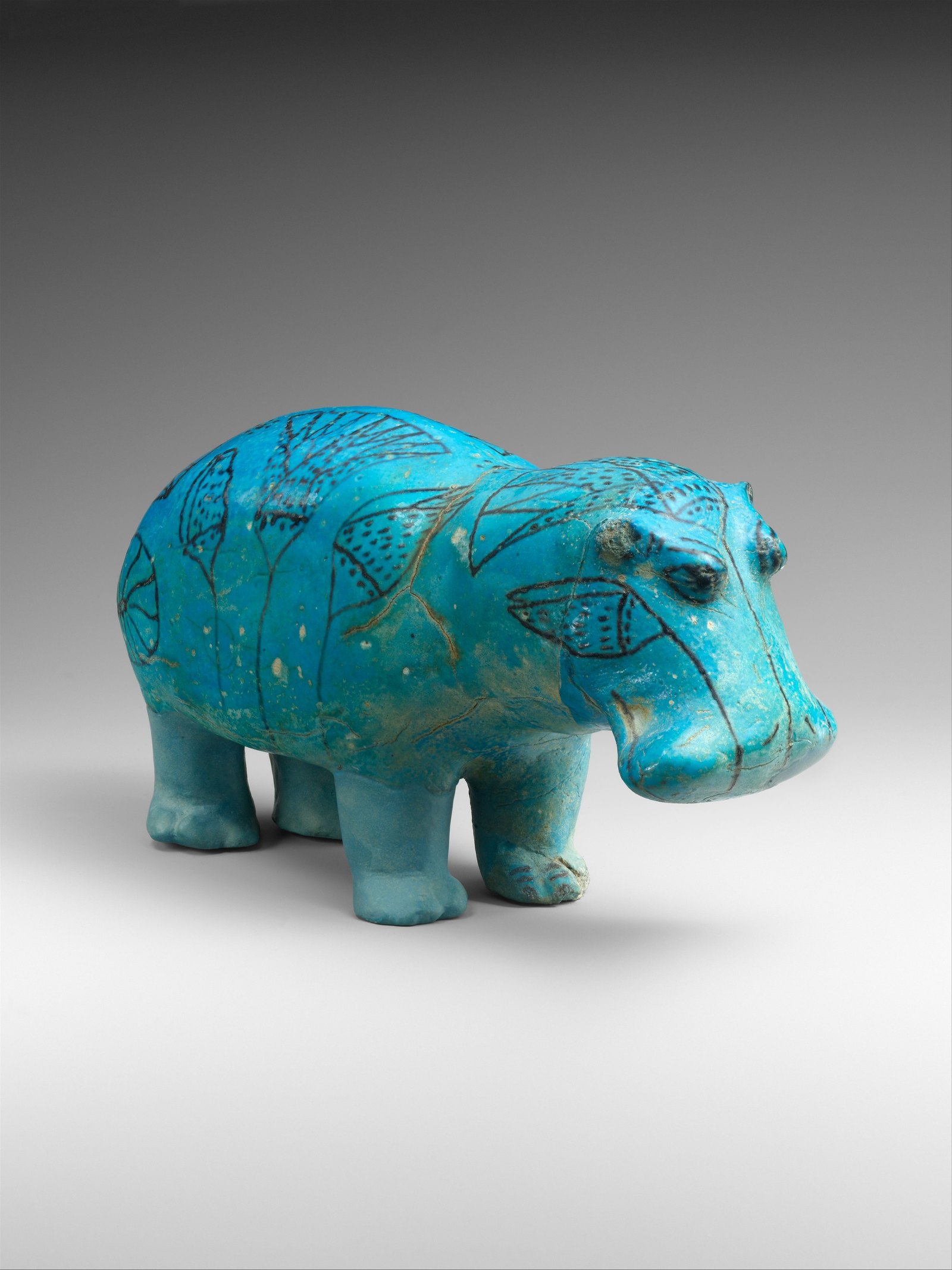
He is only 20 centimetres long — small enough to rest along the length of your hand — yet this brilliant blue hippopotamus is one of the most famous objects in the Metropolitan Museum of Art. He was molded in faience, a ceramic material made of ground quartz, and glazed the colour of the Nile. Beneath the glaze, his body is painted with lotus flowers and buds, the river plants of the marshes where real hippos lived. For the ancient Egyptians those flowers carried a hopeful meaning: lotuses close every night and open again each morning, so they symbolised regeneration and rebirth.
Do not be fooled by the cute appearance. To the Egyptians, the hippopotamus was one of the most dangerous animals in their world — a huge creature that could overturn small fishing boats and other rivercraft, and a hazard that might be met on the waterways of the journey to the afterlife. A hippo was a force of nature that had to be respected and controlled, in this life and the next. That is why this figurine was placed in a tomb: it was believed to transfer the animal's powers of life and rejuvenation to the tomb's owner, helping him to be reborn.
William was one of a pair of hippos found in a shaft associated with the tomb chapel of the steward Senbi II at Meir, an Upper Egyptian site about thirty miles south of modern Asyut. He formed part of Senbi's burial equipment, alongside a canopic box, a coffin, and numerous models of boats and food production. But the Egyptians took no chances with his dangerous side: three of his legs were probably purposely broken in ancient times so that the creature could not harm the deceased. Those legs have since been restored — if you look closely, only the front left leg, the one stepping forward, is original.
For decades he was simply inventory number 17.9.1, given to the Met by Edward S. Harkness in 1917. The name 'William' arrived only in 1931, when the British humour magazine Punch published a story about a family that kept a framed colour print of the Met's hippo at home and consulted it as an oracle, calling it William. The Met republished the story in its own Bulletin the same year — and the name stuck for good.
Today William is the unofficial mascot of the Museum, and his influence reaches further than fame. In 1919 the American artist Carl Walters visited the Met and was mesmerised by its blue faience objects, very likely including this hippo. Determined to reproduce that blue, he experimented with glazes using his apartment fireplace as a kiln, and within little more than a year he had succeeded — the colour became famous as 'Walters blue.' The Egyptian craftsman who made William never signed the work, as ancient Egyptian artists rarely did. Nearly 4,000 years later, his little hippo is still inspiring artists — and still charming everyone who meets him.
Sources
- The Met — Hippopotamus ("William"), Object 17.9.1
- The Met — Two Blue Hippos (#MetKids)
- The Met Open Access API record for Object 544227 (isPublicDomain: true)
Every fact in this exhibit was checked against the sources above. If you spot an error, write to us at downloadkaro.pk@gmail.com and we will correct it.